Trees Survive Summer Heat With 7 Expert Care Methods
Have you ever seen your trees so weary and haggard and sad in full summertime, and wondered what trouble they have with you? Similar to humans, trees are under pressure from the increase in temperatures, strong sunlight, and dry soil. Long periods of heat may undermine the trees, retard their growth, and in some cases cause irreparable damage in case of neglect.
The positive aspect is that it may be the difference between the attention in the summer. Trees may seem to be independent, and not to need your care, but you can make them feel strong, healthy and active even during the hottest months of the year, simply by paying attention to what they need and when to give it to trees.
1. Deep Water and Right Time
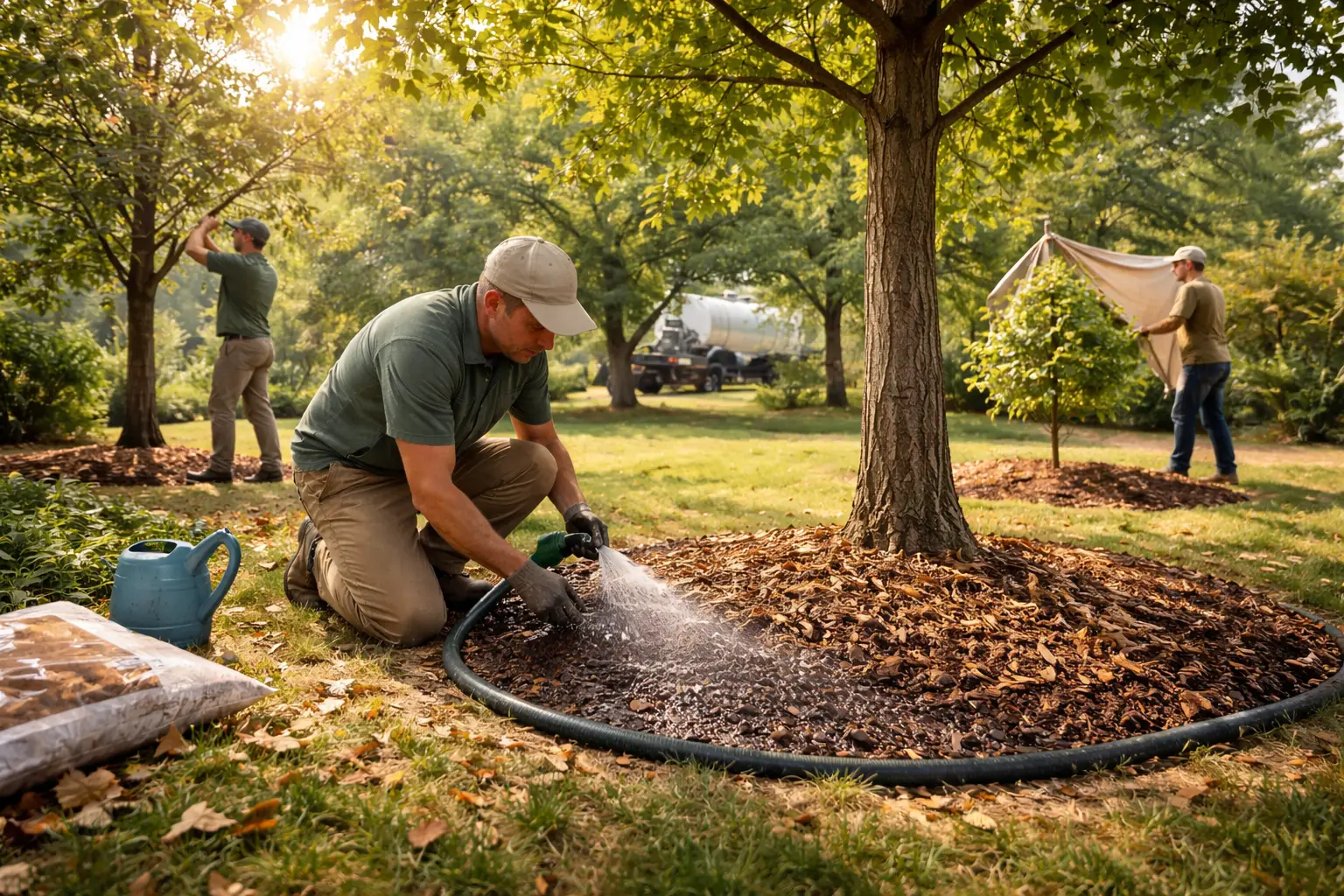
The most important thing in assisting trees to survive summer heat is watering, as per professional teams. Not every watering is, however, effective. Light is not effective because it only wets the surface and does not go deep into the roots. Deep watering, which penetrates the soil and makes roots grow downwards, is better off with trees. Mornings are the right time to water as the water has time to absorb before heat of the day can evaporate it. The underlying watering is gradual and this ensures that the roots are well supplied with the hydration that they are actually in need of.
2. Mulch to Lock in Moisture
Mulching can be referred to as a blanket for your trees. An organic mulch can be used to maintain the moisture level, control soil temperature, as well as minimise evaporation, and it can be made of wood chips, bark or compost. It also avoids competition from weeds against trees. Apply the mulch all over the root zone and ensure that it is not touching the trunk because this will lead to decay. With appropriate mulching, water loss can be significantly minimized as well as roots will not be exposed to excessive heat.
3. Protect Soil at the Roots
To have healthy soil, one requires healthy trees. The summer season can make the soil to be hard due to the walkers, gardening machines or dry weather. Hard soil causes the air and water movement to be difficult and the roots can hardly penetrate such compact soil. One should also not walk or place vehicles on the tree routes especially during hot seasons. One can also incorporate organic matter into the soil to increase its soil structure, which allows roots to breathe and take in water more easily.
4. Prune Sparingly and Minimally
Another one is pruning, but in summer, hard trimming is not a good principle. Pruning leads to a situation whereby too many branches are left bare by the sun, and this exposes the tree to the sun; the tree directly faces the sun, thus losing all its moisture and is likely to get sunburns. Unless pruning is necessary, it is better to prune off only the dead, broken or diseased branches. Light pruning is applied to improve the airflow, and it does not stress the tree. Massive pruning should be deferred to later, when the temperatures are colder, and the tree can easily be salvaged.
5. Protect the Youthful and New Trees
The summer heat has a strong tendency to affect young trees as the root systems are not well developed. They can be given temporary shade by the use of shade cloths, garden screens or even plants that are in the immediate vicinity in the event of extreme afternoon sun. Part shade is also able to alleviate stress and allow young trees to develop. Regular attention at a tender age is the basis of strength and resiliency in the long run.
6. Observations of Heat Stress
Trees are silent, but they create an understanding that they are not fine. The heat stress is typically observed to be linked to wilting leaves, yellowing, scalded edges, early leaf fall and slow growth. These are warning signs that you can be able to notice early by constantly watching your trees. Once the damage is done, quick response can be taken so that the stress is not severe by increasing watering or setting the mulch.
7. Do Not Fertilise in Excessive Heat
Even though fertilising promotes growth, it is not the best season to do it during summer. The fertilisers stimulate new growth that requires greater amounts of water and energy from the tree. This extra requirement during extreme temperatures may not strengthen but weaken the tree. Rather, pay attention to hydration and protection in summer. In case it requires fertilisation, the application of slow-release products should be employed and done during the cool seasons when trees can safely absorb nutrients.
Conclusion
It is all about taking the time and care to have your trees beat the heat in summer, as highlighted by expert crews. Such basic measures as deep watering, appropriate mulching, pruning soothingly and paying constant attention will leave a stunning impression on how your trees will handle the heat. Healthy trees can not only make your landscape beautiful but also provide shade, cleaner air and make the surroundings of your place of residence cooler. With these seven simple measures, you are bound to keep your trees strong and healthy and in good condition all summer and many seasons to come.