Tree Care Tips for Healthy and Fast Growing Cypress
Have you ever liked the graceful shape of a cypress tree, so tall and slender, and asked yourself how she was able to remain so well and so alive? Cypress trees are appreciated because of their privacy screening (without the need of maintenance), and beauty (evergreen). Whether planting a new tree or maintaining an old one, proper methods will make the difference between an average result and an excellent performance of a tree.
When well taken care of with regard to soil, water, sunlight, pruning and protection, then your cypress can last as many decades. We shall discuss how to keep and take care of cypress trees in order to grow and maintain good health.
1. The knowledge about the Cypress Trees
Cypress trees are Cupressaceae trees that are commonly used as landscaping and windbreak trees according to professional teams. The Leyland Cypress, Italian Cypress and Bald Cypress are the popular ones. These trees are known to grow very fast, evergreen and can be used in different environments. Nevertheless, even though plants require regular attention to avoid diseases, pest problems and growth disparities. The kind of cypress you have can be known and this means that you know its water requirements, sunlight and the time it needs pruning so that it will have good roots and thick foliage.
2. Choosing the Right Location
The basis of healthy development is location. The cypress trees like full sunlight and at least six hours of direct sunlight is preferred by the trees. The planting in the shaded areas may result in the formation of thin foliage and the weakening of the branches of the plants. The quality of soil is also very essential. Cypress trees are well watered in soils that are well-drained. Some of them can withstand wetness, but standing in water over an extended duration can result in root rot. The process of soil loosening and mixing of organic compost should be done before planting in order to enhance drainage and nutrient supply.
3. Watering for Balanced Growth
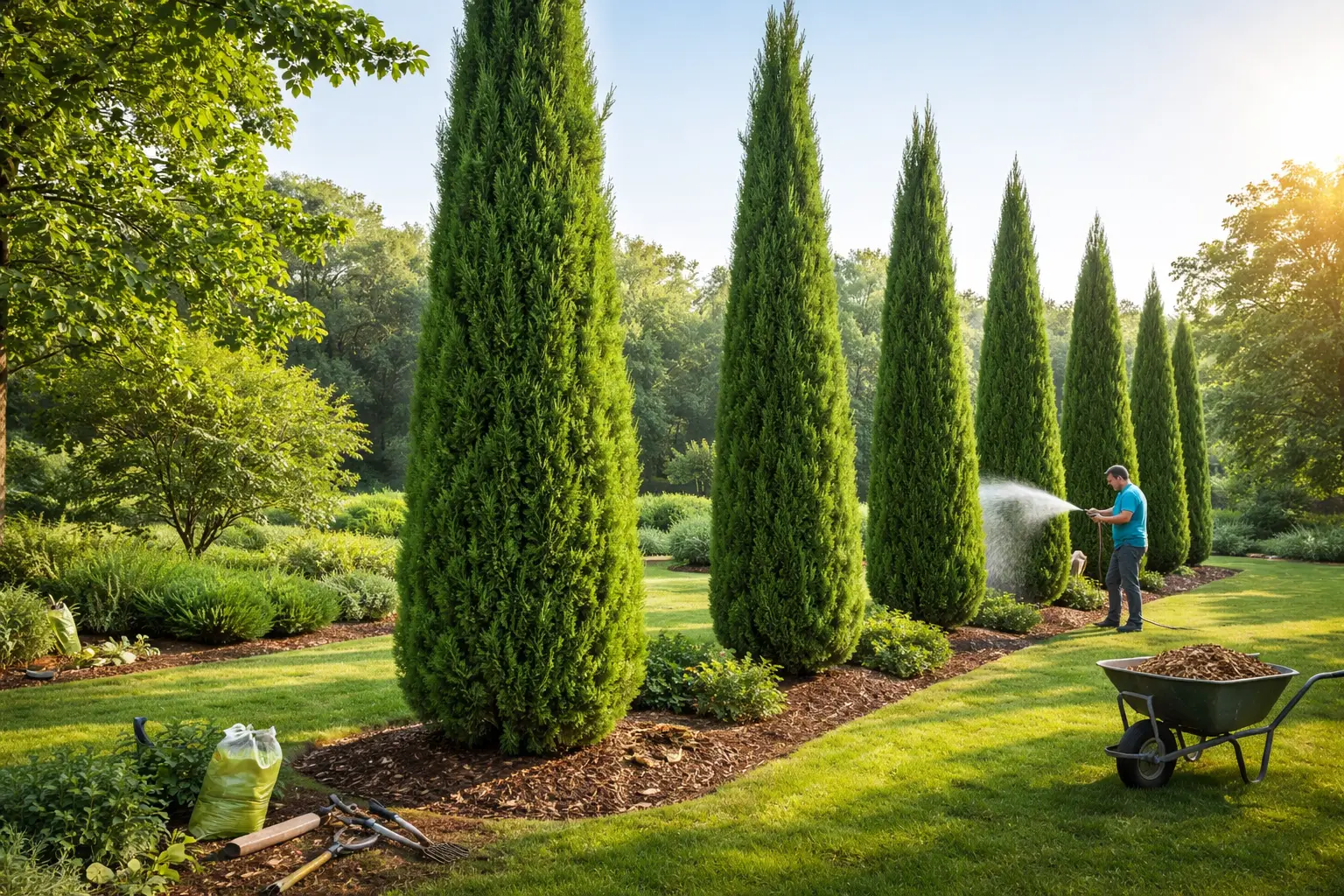
Watering is also important, particularly in the first year. Cypress trees that are newly planted require profound and regular watering of the root system. Slowly, water penetrates moisture in the soil deep down and not on the surface. Once growing the majority of cypress trees are drought-tolerant yet they will respond to frequent watering even in dry seasons. Overspraying could be equally damaging as underwatering resulting in yellowing of leaves and mushy roots. The best principle is to water when the surface layer of earth are dry. In many ways, mulching of the base will assist in retaining moisture, balancing soil temperature, and limiting competition in the form of weeds.
4. Feeding and Fertilisation
Have the right food and healthy foliage and strong branches. The cypress trees normally respond well to slow-release and balanced fertiliser applied in the early spring. Find the formula containing equal amounts of nitrogen, phosphorus and potassium. The soil can also be naturally enriched with organic compost, aged manure or feeds of trees. Fertilising should not be too much because the abundance of nitrogen can lead to excessive softening of the branches, which can get caught up by pests and also undermine the stability of the tree. Once or twice a year, feeding is usually sufficient to maintain a constant and regulated growth.
5. Pruning and Shaping
Pruning maintains your cypress in good health and makes it look good. Prune in late winter or early spring before the fruit has started growing. The first thing to remove is dead, diseased or damaged branches to increase the air circulation. The guiding of the light is to retain structure but not to cut in heavy to the old wood since cypress trees may not produce foliage on the bare branches. Cut with less force so as not to cut off their natural shape. Overcrowding is also avoided through regular pruning, disease is minimized and balanced growth is promoted.
6. Preventing Pests and Diseases
Such pests as spider mites, aphids and bagworms may infest cypress trees as with any other plant. The symptoms include discolouration, webbing or needle drop. Regular inspection of your tree and early treatment with insecticidal soap or a natural solution is recommended. Root rot or canker are fungal diseases that can be experienced in case there is poor drainage. The risk of infection is minimised by ensuring that there is proper spacing, proper watering and that the trunk is not contaminated with fallen debris. Good maintenance is the best defense as healthy trees are more resistant in nature.
7. Dealing with Weather and Environmental Stress
Cypress tree is very strong and under extreme weather, growth is slowed. When it gets hot add more water and mulch to avoid the loss of moisture. Young trees were also used to be wrapped during frost in colder climates. A high wind can blow down high varieties and it might be worth staking trees in their first year of life so that they can gain some stability. With time, a cypress that is well established will be able to sustain the environmental pressure a lot better.
8. Long-Term Care Tips
Regularity is the ingredient of best growth, also highlighted by the expert crew. Measuring the soil moisture, cleaning the foliage, changing the mulch every year, and occasional pruning are the measures to be taken. Heavy machinery or foot traffic around the base can not do a good job because it damages the roots. You will save yourself all the trouble and live a long time with a cypress that is as lush and healthy by simply observing little details.
Conclusion
The cypress tree care is a combination of intelligent planting, correct watering, sensitive pruning, and regular observation. These beautiful trees would give you privacy, beauty and long-lasting landscaping structure with the right balance. It does not take much work to keep your cypress at its best growth and as well as to ensure that it is strong, vibrant, and appealing to the eyes throughout the year.